The Osprey’s Incredible Migration: What GPS Tracking Reveals About This Remarkable Bird
For decades, scientists have used satellite tracking to understand how birds of prey navigate across continents, cross oceans, and return to familiar breeding grounds. The osprey, a fish-eating raptor found across much of the world, is particularly fascinating because some individuals travel thousands of kilometers between their summer breeding areas and wintering grounds.
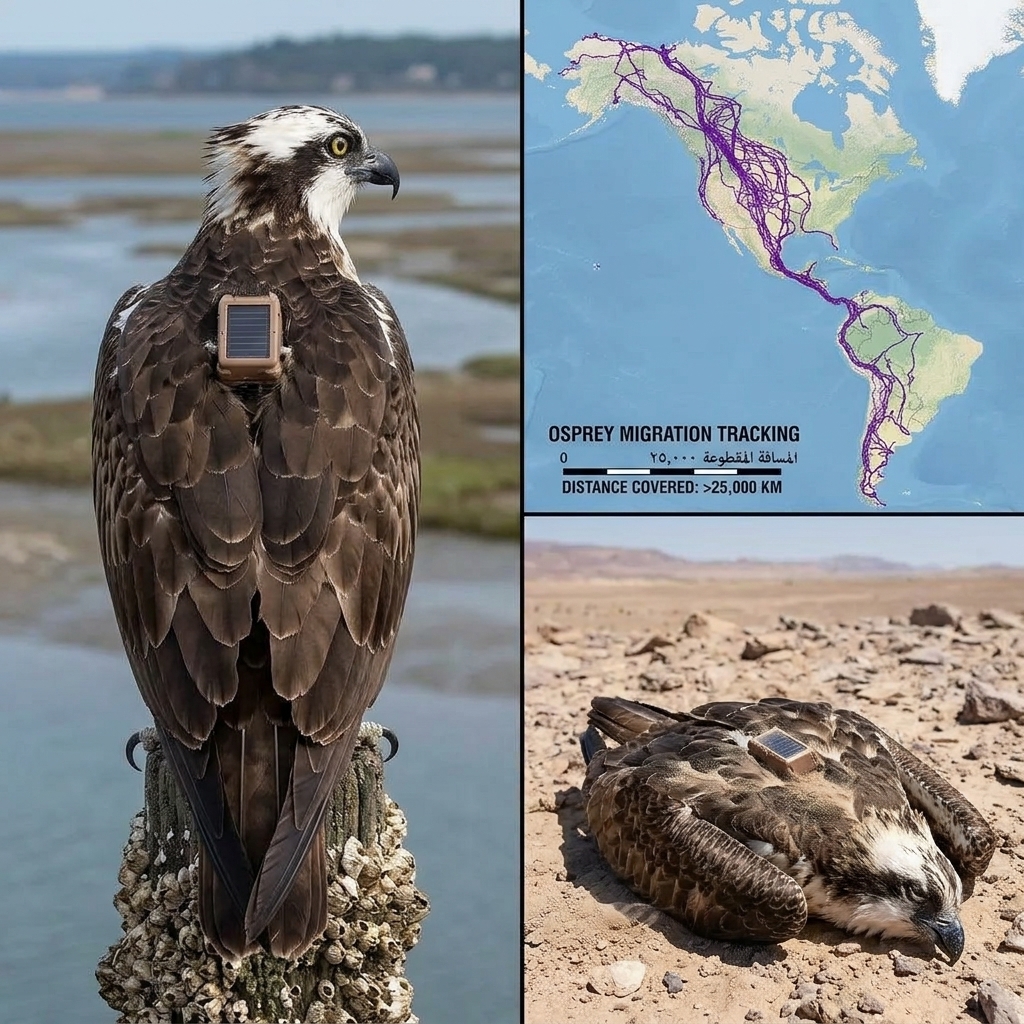
An image circulating online claims to show an eagle tracked for 20 years, with a migration route covering more than 25,000 kilometers. Although the image’s specific story cannot be verified from the picture alone, the science behind long-distance osprey migration is real and well documented.
What Is an Osprey?
The osprey (Pandion haliaetus) is a large bird of prey that specializes in catching fish. It lives near rivers, lakes, wetlands, and coastal waters, where it hunts by diving toward the water and grabbing fish with its powerful, specially adapted feet.
Ospreys are found on several continents. Many populations migrate seasonally, traveling from breeding areas to warmer regions where food remains available during winter.
How Far Can an Osprey Travel?
The distance depends on where the bird breeds, where it winters, and the route it takes. Scientific studies have documented ospreys traveling thousands of kilometers during migration.
Research tracking Swedish ospreys found that many traveled to West Africa, covering an average of approximately 6,700 kilometers during migration. Some individuals followed much longer routes, including one bird that traveled more than 10,000 kilometers to reach Mozambique.
Studies of North American ospreys have also revealed migration routes extending from the United States through Mexico and the Caribbean into Central and South America.
These journeys demonstrate how far the species can travel, although the distance shown in a particular viral graphic should not be accepted without information about the individual bird and its tracking records.
How Do Scientists Track Migrating Birds?
Researchers often attach lightweight tracking devices to birds under carefully designed wildlife research programs. Depending on the equipment, these devices can record GPS coordinates, movement patterns, and other information.
The collected data help scientists determine:
The routes birds follow during seasonal migration.
The locations where they stop to rest and feed.
The timing and duration of their journeys.
The environmental challenges they encounter.
The areas that may need protection for wildlife conservation.
Solar-powered tracking devices can sometimes provide information over multiple migration seasons, depending on the equipment, battery performance, and survival of the tagged bird.
How Do Ospreys Navigate Across Continents?
Bird migration is a complex behavior involving several navigation mechanisms. Research suggests that ospreys can maintain remarkably consistent courses, including during long flights over open water where obvious visual landmarks are limited.
Scientists study the possible roles of the Earth’s magnetic field, environmental cues, and other orientation mechanisms. The precise contribution of each mechanism can vary, and bird navigation remains an active area of research.
Ospreys also use stopover sites to rest and find food. Protecting these locations is important because suitable feeding and resting areas can influence the success of their migrations.
What Happens When a Tracked Bird Stops Moving?
GPS tracking can help researchers investigate the fate of individual birds. If a transmitter repeatedly reports the same location, it may indicate that the bird is resting, nesting, or remaining in a particular area.
However, a stationary signal does not automatically mean that the bird has died. Researchers must examine the available data and consider equipment problems and other explanations before drawing conclusions.
The image showing an osprey lying on the ground does not, by itself, establish the bird’s condition or explain why it is there.
Why This Research Matters
Tracking migratory birds provides valuable information for conservation. It can reveal important habitats, migration corridors, and areas where birds may face threats from habitat loss, pollution, or human activity.
Because migratory species cross national borders, protecting them often requires cooperation between multiple countries.
The Bottom Line
Ospreys are remarkable long-distance travelers, and satellite tracking has helped scientists uncover their migration routes in extraordinary detail. Research confirms that some individuals travel thousands of kilometers between breeding and wintering grounds.
However, the claim that the specific bird pictured was tracked for 20 years and covered more than 25,000 kilometers remains unverified based on the image alone. The established science is impressive enough without relying on an unconfirmed story.