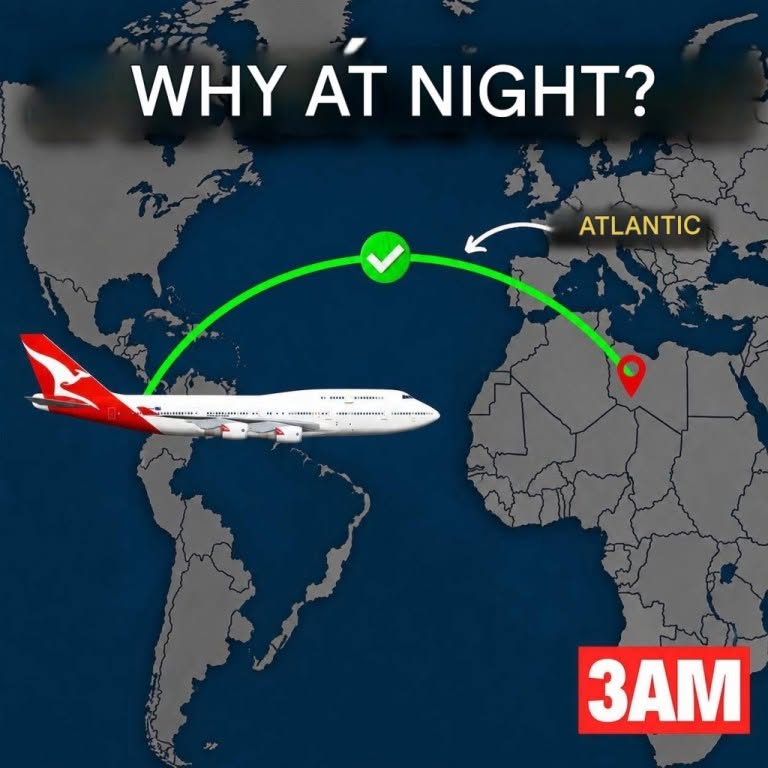
“Why don’t planes cross the Atlantic during the day?”
The surprising answer is: they absolutely do. ✈️🌍
The image is misleading because it makes it look as if transatlantic flights only cross the ocean at night. In reality, flights operate across the North Atlantic both day and night. The apparent pattern comes mainly from time zones, passenger schedules, airport capacity, and prevailing winds. skybrary.aero
🌅 Europe → North America: Mostly daytime crossings
Flights traveling west from Europe to North America are commonly scheduled to depart in the morning or during the day.
That means passengers can spend much of the Atlantic crossing in daylight before arriving in North America later that day.
The North Atlantic operations manual describes a major westbound daytime traffic flow, with peak traffic crossing around 30°W between approximately 11:30 and 19:00 UTC. skybrary.aero
🌙 North America → Europe: Often overnight
The opposite direction is different.
Airlines frequently schedule flights from North America to Europe to depart in the evening, allowing passengers to sleep during the flight and arrive in Europe in the morning.
The FAA has specifically described this scheduling pattern: airlines plan many eastbound departures in the evening so passengers can arrive in Europe in the morning ready for a day of business or tourism. Administration Fédérale de l’Aviation
That’s why you might look at a flight map and think:
“Why is almost everything crossing the Atlantic at night?”
It’s largely because the eastbound traffic wave is concentrated overnight, while the westbound wave is concentrated during the day. skybrary.aero
🌬️ There’s another important factor: wind
Airlines don’t simply draw a straight line between two airports.
North Atlantic routes are adjusted according to weather and winds, and the organized tracks are revised regularly. Aircraft may also use random routes outside the organized tracks. Administration Fédérale de l’Aviation
Strong high-altitude winds, particularly the jet stream, can make one direction considerably faster than the other.
🛫 And no — the Atlantic isn’t “closed” during the day
This is the biggest misconception in the viral post.
There is no rule saying passenger aircraft cannot cross the Atlantic during daylight.
The North Atlantic is one of the world’s busiest oceanic aviation regions, with aircraft operating around the clock. The FAA’s oceanic control system provides services for aircraft operating over huge areas of Atlantic airspace. Administration Fédérale de l’Aviation
🤯 So what’s really happening?
Think of transatlantic aviation as two major waves:
🇪🇺 Europe → 🇺🇸 North America ☀️ Mostly daytime departures/crossings
🇺🇸 North America → 🇪🇺 Europe 🌙 Mostly evening departures and overnight crossings
It’s primarily about when passengers want to arrive, combined with airport operations, time zones and weather—not because crossing the Atlantic at night is safer.
So the viral question has a misleading premise—but the pattern you’re seeing is real. ✈️🌎
📌 Did you know?
If you’ve ever flown from New York, Boston, Toronto or another North American city to London, Paris or Madrid, there’s a good chance you experienced exactly this: take off at night → sleep over the Atlantic → wake up in Europe. 😴✈️