A Massive Bald Eagle Appears in a Backyard: What You Should Know About These Powerful Birds
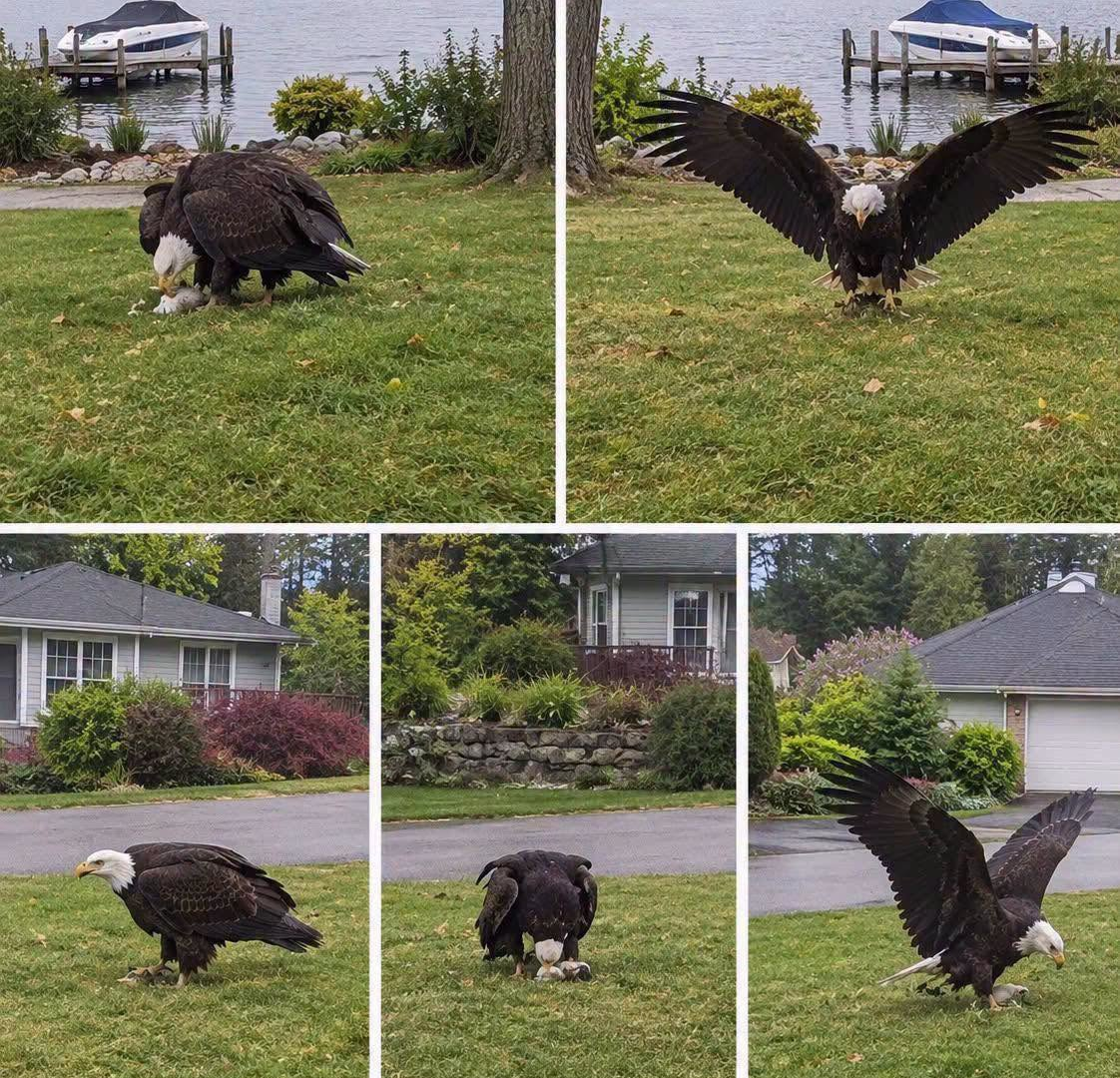
Imagine looking out into your backyard and finding a bald eagle standing on the grass, spreading its enormous wings before feeding on something nearby. It would certainly be an unforgettable sight.
Images like these often circulate online with dramatic captions, but the exact circumstances behind this particular photo collage have not been verified. Still, the scene offers an opportunity to explore the fascinating behavior of one of North America’s most recognizable birds of prey.
1. Why Would a Bald Eagle Land in Someone’s Backyard?
Bald eagles are commonly found near lakes, rivers, wetlands, and coastal areas, where food is plentiful. They may also visit residential properties close to suitable habitat.
Although fish make up a major part of their diet, bald eagles are opportunistic feeders. Depending on what is available, they may eat waterfowl, small mammals, or other animals. They also feed on carrion—the remains of dead animals. <Cite refs={[“turn166898search0″,”turn166898search3”]}/>
A backyard near a lake could therefore attract an eagle if the surrounding environment offers food, water, and suitable places to perch.
2. Why Does the Eagle Spread Its Wings?
An eagle spreading its wings while standing on the ground may be balancing, adjusting its position, or preparing to take flight. Wing-spreading can also occur during feeding or other behaviors.
However, a photograph captures only one moment. Without observing the bird over time, it is not possible to determine exactly why this particular eagle spread its wings.
3. What Makes the Bald Eagle So Powerful?
<AsyncImage query=”adult bald eagle perched white head dark brown body yellow beak wildlife photography” aspectRatio=”16:9″ width=”100%” />
The bald eagle (Haliaeetus leucocephalus) is a large bird of prey known for its white head and tail, dark brown body, hooked beak, and strong talons.
Adult females are generally larger than males, and their wingspans can reach approximately 8 feet (2.4 meters). These adaptations help bald eagles capture prey, handle food, and soar over large areas while searching for opportunities to feed. <Cite refs={[“turn166898search0″,”turn166898search2”]}/>
Despite their strength, bald eagles do not routinely attack people. Like other wild animals, they should be given space and treated with caution.
4. What Should You Do If You See an Eagle on Your Property?
If a large bird of prey lands in your yard, the safest response is to observe it from a distance.
Keep children and pets away from the bird.
Do not approach it, attempt to feed it, or try to touch it.
Give it space to leave on its own.
If it appears injured or unable to fly, contact a qualified wildlife rehabilitator or local wildlife authority.
An eagle that is feeding may remain on the ground for some time. Its presence does not necessarily mean that it is injured or behaving aggressively.
5. Is This Viral Photo Authentic?
The image itself contains the words “for illustrative purpose only,” which is an important qualification. The collage does not establish where or when the scene occurred, and it should not be presented as proof of a specific backyard encounter.
The behavior depicted is broadly consistent with what an opportunistic bird of prey might do, but that does not authenticate the photograph or confirm the story attached to it.
Final Thoughts
Bald eagles are remarkable animals whose behavior reflects their ability to adapt to changing environments and available food sources. Seeing one near a home could be an extraordinary wildlife encounter, especially in areas close to lakes or other suitable habitats.
But when a wildlife photograph goes viral, it is worth separating what the image appears to show from what its caption claims happened.
What would you do if you spotted a bald eagle feeding in your backyard? Would you watch from a safe distance or immediately call a wildlife expert? Share your thoughts in the comments!