What Is This Strange Sea Creature Found on the Beach?
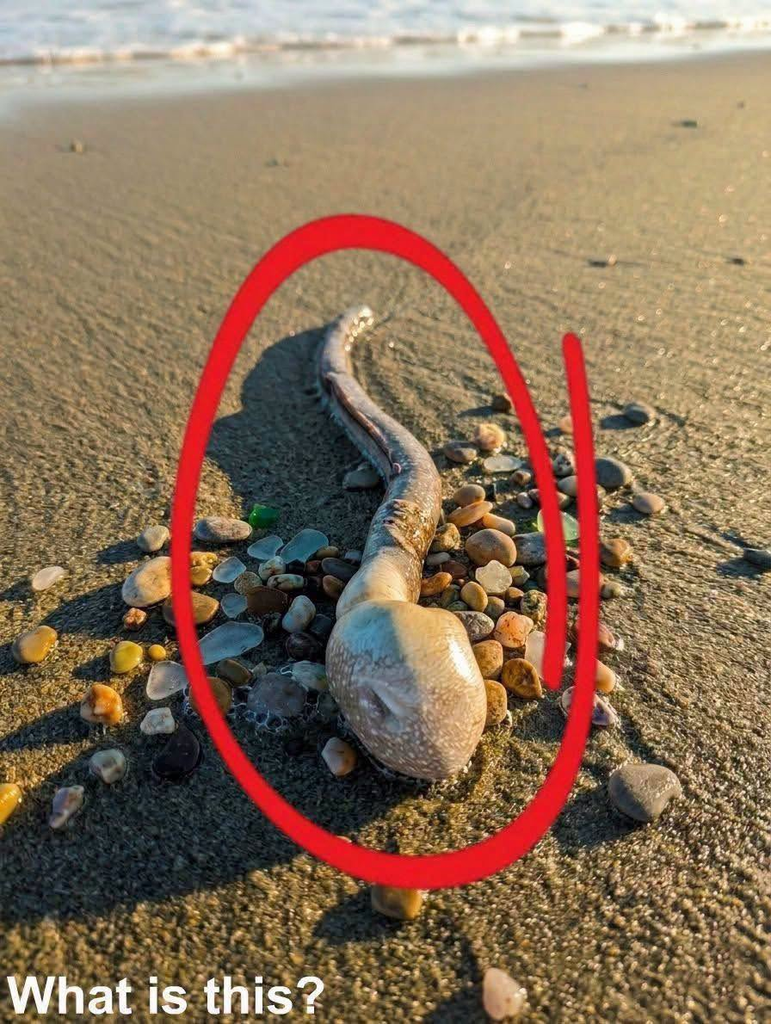
A routine walk along the beach can sometimes lead to an unexpected discovery. While walking their dog near the water, one beachgoer came across an unusual-looking creature lying on the sand. Its elongated body and swollen, rounded end made it difficult to identify at first glance.
The discovery raises an interesting question: what kind of marine animal could look like this?
Although the photograph does not provide enough detail to confirm the exact species, one possibility is a sea hare, a type of marine mollusk related to sea slugs.
Could It Be a Sea Hare?
Sea hares belong to a group of marine gastropods known for their soft bodies and unusual appearance. Unlike familiar land snails, they generally do not have a large, visible external shell.
Depending on the species and its condition, a sea hare may have a rounded body, a tapered rear section, and fleshy appendages near its head. Some species also have broad folds of skin along their sides that help them move through the water.
These animals are found in coastal environments, including shallow waters, rocky shorelines, and seagrass habitats. They feed mainly on algae and seaweed.
However, because the animal in the photograph is not clearly identifiable, its appearance alone is not enough to establish that it is a sea hare.
Why Do Marine Animals Sometimes Wash Ashore?
Finding an unfamiliar sea creature on the beach does not necessarily mean that something unusual has happened.
Waves, currents, and changing weather conditions can move marine organisms away from their usual habitats. Some animals may also become stranded when the tide recedes or when they are carried into shallow water.
Sea hares, for example, can occasionally be found stranded along shorelines. Their soft bodies may look quite different when they are out of the water, making identification more difficult.
The precise reason an individual animal ends up on the sand usually cannot be determined from a photograph alone.
What Should You Do If You Find an Unfamiliar Sea Creature?
Curiosity is natural when you discover something unusual during a beach walk. Still, it is best to observe unfamiliar marine life without touching it.
Here are a few sensible precautions:
Keep your distance. Avoid handling an animal when its identity is uncertain.
Keep pets away. Dogs may investigate unfamiliar objects by sniffing, licking, or eating them.
Take photographs safely. Pictures from different angles may help a marine-life expert identify the species.
Observe its surroundings. The location, nearby seaweed, water conditions, and approximate size can provide useful clues.
Ask a local expert. A marine biologist, natural history museum, or local wildlife organization may be able to help with identification.
If the animal appears injured or stranded, contact an appropriate local wildlife or marine rescue organization for advice rather than attempting to move it yourself.
The Importance of Protecting Marine Wildlife
Beaches are home to a wide range of organisms, many of which are rarely noticed during an ordinary walk. Sea slugs, sea hares, crabs, mollusks, and other marine animals all play roles in coastal ecosystems.
Observing these creatures responsibly helps protect them and allows others to learn more about the biodiversity found along the shoreline.
Even an unfamiliar-looking animal can offer an opportunity to discover something new about marine life.
Final Thoughts
The unusual creature in this photograph may be a sea hare or another soft-bodied marine animal, but a reliable identification would require additional information, especially the location where it was found and clearer details of its body.
Have you ever come across a strange marine creature while walking along the beach? Sharing the location and additional photographs can help others narrow down the possibilities and learn more about the animals that inhabit our oceans.