Found These Strange Plastic Pieces in Grandma’s Drawer? Here’s What They Were Really Used For!
Have you ever opened an old drawer at your grandmother’s house and discovered a collection of strange objects you couldn’t identify? Sometimes, the most ordinary-looking items can reveal fascinating stories about how people lived, dressed, and cared for themselves decades ago.
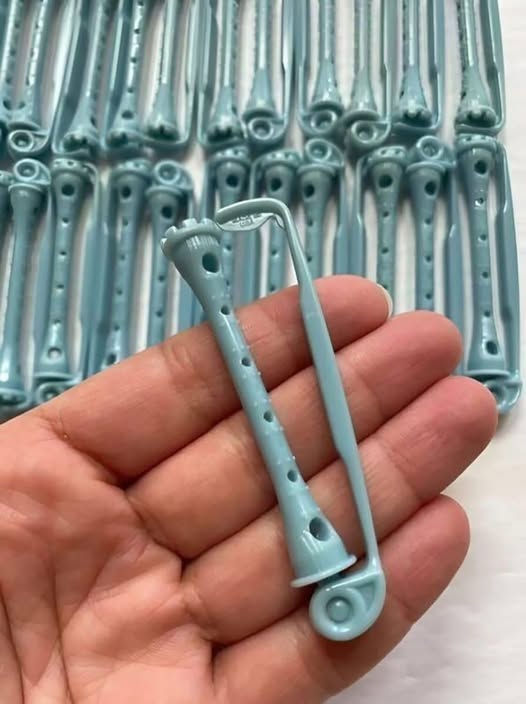
The unusual blue plastic pieces in this photograph might look like broken toys or useless scraps at first glance. But they are actually a type of vintage hair-perming rod, a tool once widely used to create curls and waves that could last for weeks or months.
Before modern styling tools became common, these little devices played an important role in home hairstyling and professional beauty salons.
So, how did they work, and why were there so many of them in Grandma’s drawer?
What Are These Strange Plastic Objects?
These objects are old-fashioned perm rods, also called permanent-wave rods or perm curlers.
They were designed to hold sections of hair in a curled position during a chemical perm treatment. The small holes in the plastic allowed liquid and moisture to pass through, helping the hair receive the treatment.
The curved plastic piece attached to the rod acts as a securing arm or clip. It helps hold the hair in place while it is wrapped around the cylinder.
Similar designs were used in home-perming kits and professional salons, particularly during the decades when permanent waves became a popular hairstyle.
How Did Vintage Perm Rods Work?
Creating a permanent wave involved more than simply wrapping hair around a roller. The process used specialized products to change the hair’s structure and then set it into a new shape.
Step 1: Preparing the Hair
The hair was divided into small sections. Depending on the product and technique, it was washed and prepared before the perming process began.
Step 2: Wrapping the Hair Around the Rod
Each section of hair was carefully wound around a perm rod. Hairdressers often used small pieces of special paper, called end papers, to keep the ends smooth and help them wrap evenly.
The securing arm or clip helped prevent the hair from unwinding during treatment.
Step 3: Applying the Perm Solution
A chemical waving solution was applied according to the product’s instructions. This treatment altered bonds in the hair that contribute to its natural shape, allowing the hair to take on a new curl pattern.
The perforations in the rods helped the solution reach the wrapped hair.
Step 4: Neutralizing and Setting the Curls
After the required processing time, the hair was rinsed as directed and treated with a neutralizer. This helped stabilize the new shape.
The rods were then removed carefully, revealing the newly formed curls or waves.
Chemical perms require careful handling because incorrect use can damage hair or irritate the skin.
Why Were There So Many of These Rods?
A single perm generally requires multiple rods because the hair is divided into many small sections.
The number needed depends on the person’s hair length, thickness, desired curl pattern, and the size of the rods.
Smaller rods generally create tighter curls, while larger rods tend to produce broader waves or looser curls.
Having a complete set at home was useful for people who styled their hair themselves or regularly gave family members perms.
Why Do Vintage Perm Rods Have So Many Holes?
The holes are not decorative. They are part of the practical design.
They allow liquids and moisture to move through the rod rather than leaving the hair completely enclosed inside a solid cylinder.
The exact design varies by manufacturer and model, but perforations are a common feature of older hair rollers and permanent-wave equipment.
Why Were These Tools So Popular?
Permanent waves became an important part of hairstyling during the twentieth century. They offered a way to create curls that lasted much longer than curls produced by temporary styling alone.
Home-perming kits made the process accessible to people who wanted salon-style results without visiting a professional every time.
For many families, a box of perm rods was a familiar part of the bathroom cabinet or dressing table. Finding a set today can bring back memories of family hairstyling routines, beauty salons, and hairstyles that were fashionable at the time.
Are These Old Perm Rods Still Useful Today?
Some vintage perm rods can still be useful for people who understand how to use them and can confirm that the equipment is in good condition.
However, old plastic can become brittle with age, and damaged clips may not hold hair securely. Anyone considering reusing vintage equipment should inspect it carefully and follow the instructions for a compatible, current hair-treatment product.
It is also worth remembering that the rods themselves do not make hair permanently curly. The chemical process is what creates a lasting change in the hair’s shape.
Final Thoughts: A Small Piece of Hairstyling History
What initially looks like a collection of strange plastic pieces turns out to be a practical tool from an earlier era of beauty and hairstyling.
Vintage perm rods remind us that many everyday objects were designed with a specific purpose in mind, even when that purpose is no longer immediately obvious.
A simple discovery in an old drawer can reveal how people created their favorite hairstyles long before today’s styling gadgets became commonplace.
Do You Remember These Old-Fashioned Hair Curlers?
Did your mother or grandmother use perm rods like these? Perhaps you remember seeing them in a bathroom drawer, a beauty salon, or a box of old hairstyling supplies.
Share your memories in the comments! We’d love to hear which hairstyles were popular in your family and whether you ever tried a home perm.