Those White Strings in Your Beef Roast Aren’t Worms — Here’s What They Really Are 🥩
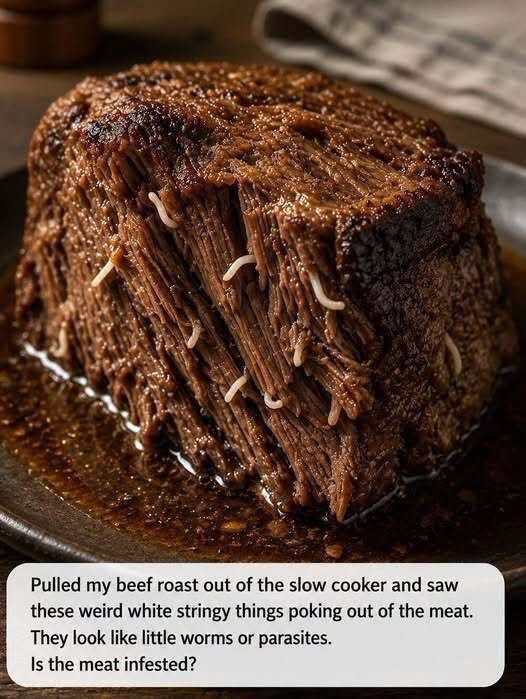
You take your beef roast out of the slow cooker, look closely at the meat, and suddenly notice thin white strings sticking out from between the fibers.
At first glance, they can look surprisingly similar to small worms or parasites.
But in many cooked beef roasts, these white, stringy structures are not worms at all. They are usually natural parts of the meat that become more visible after hours of slow cooking.
🥩 So, Is the Beef Infested?
Not necessarily — and the appearance in this photo does not by itself prove that the meat contains parasites.
Beef is made up of bundles of muscle fibers, connective tissue, collagen and fat. During slow cooking, heat gradually breaks down collagen and other connective tissues.
As the meat becomes tender and separates, some of these pale fibers can pull away from the muscle and become exposed on the surface.
That’s one reason cooked meat can sometimes develop strange-looking white or cream-colored strands.
🔍 Why Do They Look Like Little Worms?
The appearance can be misleading.
Before cooking, connective tissue is tightly integrated with the muscle. After several hours in a slow cooker, the meat softens and the muscle fibers separate.
Some connective-tissue fibers can then stick out from the roast.
Because they are:
Thin
White or pale
Curved
String-like
Embedded between muscle fibers
they can look remarkably similar to worms in a photograph.
But appearance alone isn’t enough to identify a parasite.
🧬 What Is Connective Tissue?
Connective tissue is a normal component of meat.
One important protein found in connective tissue is collagen. When beef is cooked slowly at an appropriate temperature for a long period, collagen can gradually break down into gelatin.
This is one of the reasons cuts such as chuck roast become tender and juicy after slow cooking.
So those unusual white strands may simply be part of the structure that helped hold the muscle together before cooking.
⚠️ What About Actual Parasites?
Parasites are a different issue.
Some parasites can infect meat, but you should never diagnose a parasite simply by looking at a photograph of a cooked roast.
If you genuinely suspect that meat is contaminated, don’t continue eating it just because the visible strands don’t look dangerous.
Pay attention to other warning signs too, such as:
Unusual movement in the material
Abnormal odor
Unexpected discoloration
Spoilage or slime
Meat that was improperly stored
Meat from an uncertain or unreliable source
Evidence of contamination before cooking
When in doubt, it’s safer to stop eating the meat and contact the seller, butcher or an appropriate food-safety professional.
🌡️ Cooking Temperature Matters
Another important point is that slow cooking doesn’t mean that food safety can be ignored.
Large beef roasts should be cooked using a reliable food thermometer and according to appropriate food-safety guidance.
Don’t rely only on color or texture to determine whether meat is safe.
And remember: cooking can make meat tender, but proper handling, storage and cooking are all important for food safety.
❌ Don’t Pull Everything Out and Keep Eating Without Checking
If you see something unusual in your roast, don’t immediately assume either:
“It’s definitely a parasite!”
or:
“It’s definitely harmless!”
A photograph isn’t enough to establish either conclusion.
If the material looks like normal connective tissue and the meat was properly handled and cooked, the strands may simply be part of the beef.
However, if the meat looks spoiled, smells abnormal, was stored improperly, or you have a genuine concern about contamination, discarding it is the safest option.
🥩 The Bottom Line
Those creepy-looking white strands in a slow-cooked beef roast can simply be connective tissue or collagen that has become exposed as the meat cooks and separates.
They may look like tiny worms, but you cannot determine that something is a parasite just from its appearance in a photo.
So before throwing away your roast in panic, remember:
Not everything that looks like a worm in cooked meat is actually a worm. 🥩
But if you’re genuinely unsure about the safety of the meat, it’s always better to be cautious and avoid eating questionable food.
📌 Did you ever find something strange-looking inside cooked meat?
Share this article with someone who would immediately panic after seeing these white strands! 👇👇